

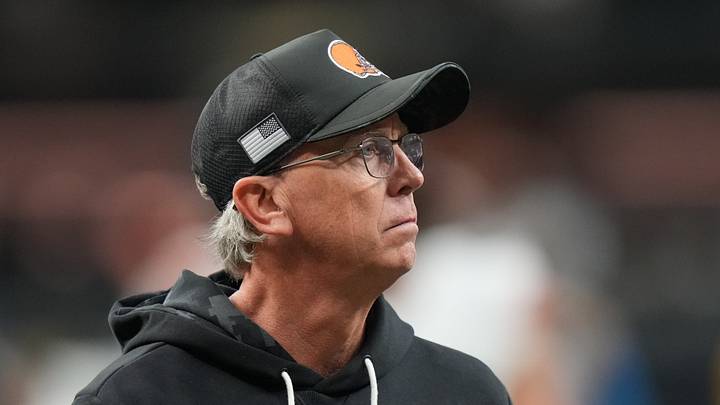
In Week 9, the Cleveland Browns had a new starting quarterback, rolling with Shedeur Sanders after Deshaun Watson missed the week of practice while in concussion protocol. The second-year Sanders played a good game against the New Orleans Saints, with the Browns falling one play short in the 23-22 overtime loss.
There was a lot of excitement to watch Sanders, and the quarterback delivered, making multiple big plays and giving Cleveland a chance to win. Now, there’s a discussion amongst fans and media members about whether Sanders should remain the starter, or if the Browns should turn back to Watson.
A common point brought up in the discussion is that Cleveland’s offense with Sanders followed the same trend as the offense when Watson is at quarterback. That trend is three quarters of rough football before flipping a switch and turning into a good offensive unit in the fourth quarter.
Everyone initially assumed that was a Watson problem, but with Sanders stepping in and immediately doing the same thing, the focus has now shifted to Browns head coach Todd Monken, who’s also the offensive play caller.
With two different quarterbacks now starting slow and heating up late, it’s worth asking if Monken is to blame for being too conservative early.
Could Todd Monken be the reason for Browns’ slow offensive starts?
Cleveland has been abysmal early in games and has made a habit of staging late-game comebacks. The Browns did it five times with Watson in the first eight weeks, putting together five game-winning drives, and the team nearly did it with Sanders in his first start of the year.
On Sunday against New Orleans, the Browns had scored just six points through the first three quarters, and Sanders only had 100 passing yards. However, after falling behind to the Saints, 9-6, with under 6 minutes left in the fourth quarter, the offense flipped a switch.
Cleveland’s very first play after New Orleans took the lead was a 64-yard passing touchdown. After forcing a three-and-out, the Browns had an unsuccessful four-minute offense attempt that would’ve put the game on ice and gave the ball back to the Saints again.
New Orleans quickly drove down the field and took the lead with a touchdown, putting Cleveland back in the position to chase. As the Browns have proven all year, they are comfortable in that spot, and they responded with a quick, seven-play, 41-yard drive to kick an overtime-forcing field goal.
When the Saints drove down and scored a touchdown in overtime, Cleveland came right back with a touchdown of its own. As we know, the Browns ultimately lost because of a failed two-point conversion attempt, but the offense put together three scoring drives in gotta-have-it moments after being desolate all game.
There's more to that than just being clutch, and it likely starts with play calling. The Browns have a solid defense, so it wouldn’t be a surprise if Monken is calling the offense in a conservative fashion so they don’t hurt themselves, which also limits the ceiling of production.
At the end of the game, however, caution is thrown to the wind, and it has often resulted in the Browns offense looking like a really good unit.
Speaking with the media on Monday, Todd Monken admitted that he was evaluating himself to see if the way he’s calling games early versus when the team is down late is contributing to the slow starts.
"We’re fighting like hell, we’re looking at what we’re calling. Obviously, in the fourth quarter, it’s a little bit different because we’re throwing it a ton and we’re getting it to those playmakers. So you gotta look at that. What are our play calls? How are we scheming it? What are we doing early in the game?… Certainly, we’re going to fight like hell to fix it."
It’ll be interesting to see what Monken’s self-scout finds, and hopefully it finds a solution to the team’s slow offensive starts. It would be great if it’s something as simple as the play calling not being aggressive enough early, because that’s an easy fix.
Whatever the problem is, the Browns need to address it fast, because they won’t be able to keep climbing out of holes.
 Add us as a preferred source on Google