

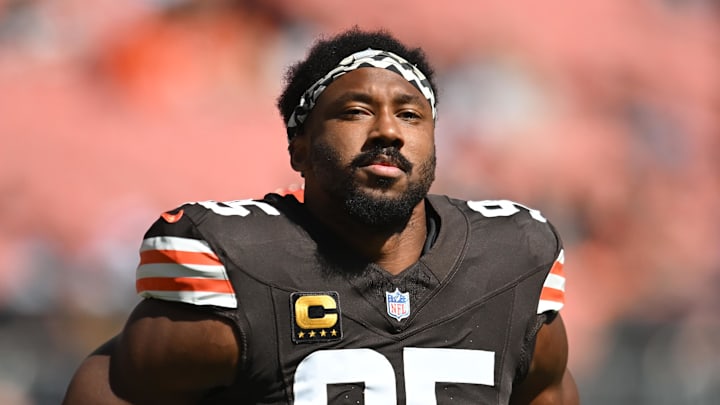
The days of NFL general managers subtly adjusting a player’s contract during the offseason are long gone. Fans have never had more access to information, thanks to useful sites like Over the Cap and Spotrac. Salary cap sleuths are all over every team’s bonus and payout structure, especially for a mega star like Myles Garrett.
We’ve reached the point where even a minor, nothing-to-see-here change in the language in Garrett’s contract was enough to generate national headlines on Thursday morning. GM Andrew Berry and company shouldn’t be surprised, either, as their decision to push back the option bonuses in Garrett’s deal from late March to September of each year begs the question: What’s the motive here?
Per OTC founder Jason Fitzgerald, that move, made prior to Garrett’s 2026 option bonus being due on Wednesday, didn't clear additional salary cap space for the Browns this year. The team did convert some cash from future base salaries into roster bonuses, which benefits Garrett, per ESPN reporter Field Yates, but the team won’t see cap relief from these moves until the 2029 league year.
What these moves do, according to Fitzgerald, is give the Browns added cap flexibility for the future, which NFL insider Adam Schefter confirmed via a team source on the Pat McAfee Show on Thursday.
“I called the Browns and they said they’re 100% not trading Myles Garrett,” - @AdamSchefter 👀👀👀 pic.twitter.com/cP5GrfH1LE
— ESPN Cleveland (@ESPNCleveland) March 26, 2026
Pushing the option bonuses out closer to the start of the regular season also gives both Garrett and the Browns added flexibility to explore a trade, potentially as soon as this summer, when after June 1, the team could now actually save $8.1 million in immediate cap space by moving the future Hall of Famer. Both parties would need to align on a deal, though, as Garrett would first have to waive his no-trade clause to make a trade possible.
With all due respect to Berry, no one cares about the team’s added flexibility to do annual cap gymnastics. What’s interesting is the flexibility around a Garrett trade, which dominated national headlines prior to the Super Bowl in 2025 and was reignited by Yates’ report on Garrett’s contract adjustment on Wednesday evening.
The Browns wasted no time executing some damage control through Schefter, who told McAfee on Thursday that a Garrett trade was “100 percent” not happening.
“Let me say this: Right away I called the Browns. I’m like, what’s going on here? And they’re like, ‘We are 100 percent, definitely not trading him.’ … They were adamant about it, and they’re like, ‘Don't even bring it up and dignify the fact, because we’re not trading him. … This was done to give us more cap flexibility.’ They couldn’t have been stronger about it, but that’s not going to discourage other people from wondering and speculating, could he be traded? I’m just telling you. They told me no.”
The Browns insist Myles Garrett isn’t going anywhere (but the contract tells a different story)
To be clear, Schefter never clarified his comments to reflect the 2026 season only. There’s no such thing as “100 percent” in the NFL world, but a Garrett trade this summer does feel highly unlikely.
While the Browns would gain some immediate cap savings, their expected haul of draft capital wouldn’t be realized until 2027 and beyond. They would need to recoup a record-setting haul, on top of an impact player — like Cowboys wide receiver George Pickens, perhaps? — to even consider broaching that subject with Garrett's camp this year.
Fans, however, shouldn’t take Schefter’s report at face value. While the chances for a trade this year may be slim-to-none, that’s not the case in future years. In 2028, for example, when Garrett will be entering his age 33 season, the Browns could trade him prior to that year’s draft under the current framework of his deal, and the team would still save over $16 million in cap space.
Schefter was sure to make the Browns' loyalty to Garrett crystal clear, and understandably so. But barely a year ago, Garrett went public with his desires to play elsewhere and compete for Super Bowls. A couple months later, he signed an extension with Cleveland that at the time made him the highest-paid non-quarterback in league history.
Things change, sometimes in the blink of an eye. If the Todd Monken era gets off to a slow start, it would 100 percent surprise no one if the two sides more amicably discuss next steps this time around.
 Add us as a preferred source on Google