

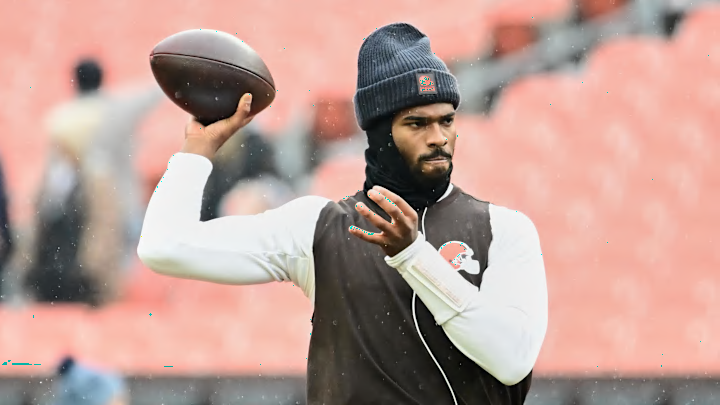
Rookie quarterback Shedeur Sanders and the Cleveland Browns played in some frigid weather in last week’s home game against the Tennessee Titans, but Sunday’s trip to Soldier Field will add a higher degree of difficulty.
This won’t exactly be the famous Lambeau Field “Ice Bowl” of 1967, but it’ll be up there.
An expected arctic blast in the Windy City is expected to produce wind chills of around minus-15 degrees during the Browns’ 1 p.m. road game against the Chicago Bears on Sunday. That goes a bit beyond ideal football weather, and could put a heavy emphasis on the running game for both teams.
All eyes will be on Sanders, of course, as he looks to build off last week’s 364-yard, breakout performance against the Titans. How he leads a depleted offense that will be down tight end David Njoku, running back Dylan Sampson, and a number of offensive linemen, in harsh conditions, will be the most telling factor of his fourth NFL start.
Sunday’s Arctic blast could define Shedeur Sanders’ rookie season
Sanders’ first NFL start was played inside a dome against the Las Vegas Raiders. He’s dealt with typical late-season outdoor football conditions ever since.
In his debut start at Huntington Bank Stadium, wind gusts that reached up to 40 miles per hour drastically impacted the passing game in Cleveland’s 26-8 loss to the San Francisco 49ers. Wind wasn’t as much of a factor in last week’s 31-29 loss to Tennessee, but the game was played in snow flurries with temperatures near freezing.
According to the Weather Channel, the Browns will be lucky to see temperatures in the low teens for Sunday’s kickoff in Chicago. It’ll feel about 30 degrees colder than that when you factor in the wind chill.
To be clear, this won't rival the coldest games in NFL history, which have all landed later in the year, deep in the postseason. The "Ice Bowl" was played at a game-time temperature of minus-13 degrees, with wind chills climbing close to negative-50. That’s cold enough to freeze the sweat before it even forms.
Sunday’s game could, however, rival the NFL’s coldest regular-season game on record, which was Packers-Vikings at Minnesota’s old Metropolitan Stadium in 1972. It was 0 degrees at kickoff with wind chills registering at minus-18; the teams wound up combining for 30 points in Green Bay’s 23-7 win.
Clearly, this isn’t the kind of weather you’d expect for a game played in early December, but if Sanders wants to prove he’s Cleveland’s QB of the future, his ability to handle conditions like Sunday could go a long way.
 Add us as a preferred source on Google