

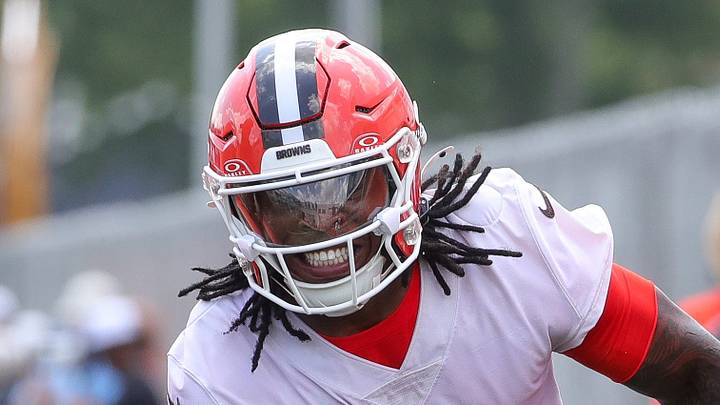
Quinshon Judkins is staring down the barrel of a golden opportunity. Not many NFL backs with a sub-4.0 average yards-per-carry find themselves in the enviable position of being a team's unquestioned bell-cow back with little to no competition for their spot. In a lot of ways, Andrew Berry crowned Judkins as a franchise running back in 2026, regardless of whether he meant to.
The Browns saw Judkins lead the way in the run game in 2025, notching 230 carries for 827 yards (3.6 average) and three TDs. That was apparently enough for the Browns to allow Jerome Ford to walk and ignore the position entirely in free agency. Ditto for the NFL Draft. The Browns did opt to sign two undrafted free agent backs in Davon Booth and T.J. Harden, but otherwise the pressure on Judkins is seemingly only from within.
The 2025 Cleveland Browns were hardly a team oozing with Pro Bowl talent. That's a real factor that deserves consideration when evaluating Judkins' rookie campaign. His 1.47 average yards before contact indicates his offensive line wasn't doing him many favors. It doesn't quite end there, either.
The NFL's highest stacked-box rate made life miserable for Quinshon Judkins
The Browns faced a loaded box on 45.22 percent of Judkins' runs. This was the highest rate in the league. The crushing indictment against Cleveland's quarterbacks notwithstanding, Judkins was doomed to put up inefficient numbers facing eight-man boxes on nearly half his carries. The fact that he was still able to put up respectable stats had Browns fans excited.
When NFL analytics expert Warren Sharp published his site's running back rankings, fans were probably somewhat excited to see where the Browns ranked. A click and ... 26th. Ouch. Once the explanation comes out, though, it becomes harder to dismiss.
"Quinshon Judkins gained five or more yards on just 25% of his carries, ranked dead last out of 55 running backs with at least 75 carries. Think that is the offensive line’s fault? Even when he crossed the line of scrimmage without contact, he still ranked dead last (45%). Unless he makes a drastic leap forward, there’s little hope for improved production from the Browns' backfield."
Judkins is billed as a bruising back who will break tackles through sheer power and grit, a la Peyton Hillis. The fact that his yards-after-contact average (2.12) ranked 47th in the league out of 65 running backs with more than 50 carries is slightly alarming, especially considering some of those near the top, such as the Buffalo Bills' James Cook and Miami Dolphins' De'Von Achane, are considerably smaller.
The problem traces all the way back to the yards-before-contact debate. The issue is more nuanced than it appears. Just because Judkins broke through the line of scrimmage without contact doesn't mean the contact wasn't near instant as he exited the other side. Stacked boxes have a tendency to shrink the space for the running game. Absent a passing game to force the defense to back up, running backs will almost always suffer.
If you've been following the NFL for a while, you're familiar with Derrick Henry. Now, stick with me for a minute, because no one is saying Judkins is Henry. Many defenders have said the strategy with Henry is to hit him early on. Once he gets the steps necessary to build up his speed and power, it becomes infinitely more difficult to bring him down. That narrative also applies to Quinshon Judkins.
As a 220-pound running back, Judkins isn't about outrunning a cornerback or spin-moving a linebacker in open space. He wants to run right through you and keep on chugging. For him to reach his potential, the Browns' offensive line — which should be much improved in 2026 — must afford him the time to build up his speed and power.
If the team fails again in that department, Judkins' numbers will likely not impress. While he is certainly responsible for breaking tackles and making the most out of his carries, football will always be a team game. If anyone should be ecstatic about what Todd Monken is going to bring the Browns' offense in 2026, it's Quinshon Judkins.
 Add us as a preferred source on Google