

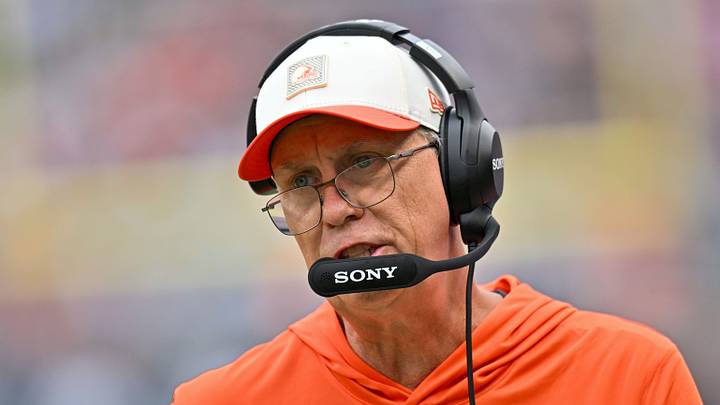
The analytics takeover in sports has been going on for decades now. Old-school sports fans and coaches — like Todd Monken of the Cleveland Browns — have no choice but to accept it. In the modern NFL, it’s adapt or die.
But there’s an analytically driven decision that has almost become automatic in the league — going for 2 down 14.
The logic, as Monken explained perfectly to reporters (and by extension, the fans) on Friday, comes down to simple math and percentages. If a two-point conversion is successful about 50% of the time, and you score a touchdown down 14 points in the fourth quarter, going for two is the right play over time.
If your conversion attempt fails, you’re still down by eight points, or one score. If the conversion succeeds, you now trail by six and could potentially win the game by one with another touchdown and the higher-percentage extra-point attempt.
“Where you guys all know where it comes from is basically that it’s 50-50 by statistics. 50-50 in terms of converting a two-point conversion. So, the point is if it’s 50-50, why wouldn’t you go for two the first time? If you happen to get it right the first time, then the extra point wins it. That’s the point.”
Wel said and often what I’ve spoke about on this
— Dan Orlovsky (@danorlovsky7) November 28, 2026
-who is my team
-do I love the play(s) we have
-do I like our matchups
Also—% https://t.co/FogzZEr6aT
NFL analytics can't fully account for the psychological impact of going for 2
The problem with this decision is that, while the math makes sense over time, it rarely ever works. There are a ton of variables that need to be weighed along with the 50-50 conversion odds, and the biggest one revolves around human psychology.
This situation came up in the Eagles-Cowboys game on Thanksgiving. The Eagles trailed by 14 points, 38-24, with 10:41 remaining in the fourth quarter. Head coach Nick Sirianni made the snap decision to go for two. Tom Brady and Kevin Burkhardt barely even discussed the decision in real time on the TV broadcast.
The attempt failed with a Joe Milton incomplete pass. The Eagles managed to score another touchdown just before the two-minute warning, and their conversion attempt failed again, leaving them down by two, 38-36.
In most situations, those failed conversion attempts would have cost Philly the game. But the Eagles were playing the Cowboys, who can’t get out of their own way. The Eagles managed to get the ball back and kick a game-winning field goal with 2 seconds remaining.
So the strategy worked, I guess?
The Browns have encountered a comparable situation once this season, in the first half of their game against the Houston Texans. They trailed 17-0, scored a field goal to cut the deficit to 14 points, and then scored a touchdown late in the second quarter. Monken took the extra point to go down seven. Had it been the fourth quarter, though, he might have elected to go for two.
Since 2023, 20 teams have gone for 2 down 14 with less than 10 minutes remaining in the fourth quarter, according to the Associated Press. Only three teams converted and finished the strategy with a one-point win — a 15% success rate for that specific outcome.
Again, it’s the psychology piece that should be a bigger part of the discussion. Scoring a touchdown down 14 with enough time left to get another possession creates momentum. Kicking the extra point to go down seven naturally builds momentum for the scoring team, while applying pressure to the opponent on the ensuing drive.
The difference between trailing by seven or eight on the scoreboard late in a game, in terms of belief on the sideline, is astronomical.
The most interesting part of this debate is that it originated in Cleveland.
Bill Belichick was the first head coach to try the strategy back in 1994. The Browns went for two down 14 and converted to make it 20-14. The Browns couldn’t get a stop on defense, though, and wound up losing 26-14.
Todd Monken's aggressive approach could put Browns at center of 2-point debate
What will Monken do when faced with this exact situation in a big spot? That remains to be seen.
For the most part, he’s leaned toward being aggressive, like going for the win in overtime rather than a potential tie in New Orleans.
Monken's comments on Friday seemed to hint that he would trust his players’ ability to convert on offense.
“I think that, taking into account of going for two… or being aggressive, I think a lot of it has to do with your belief in your group, right?” Monken said. “Depending on who your quarterback is, who your skill players are, how you are up front — you’re going to have a heck of a lot more confidence in going for it. When you have confidence in your players, your scheme, just like you would if you feel like you have an elite defense, right? … So that comes into play, as we all know. It’s really not — it’s not hard. You guys see it and you just have to make a decision and live with the results.”
 Add us as a preferred source on Google