

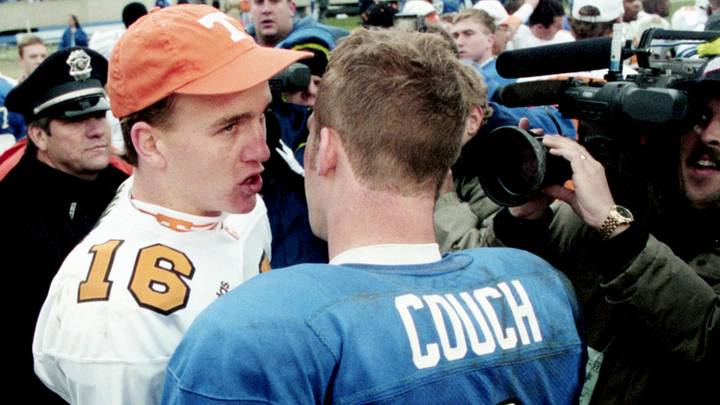
The Cleveland Browns have been searching far and wide for a long-term franchise quarterback over the last quarter century. With the 2026 team away for the summer break, here at Dawg Pound Daily we’ve decided this is the perfect time to take a stroll down memory lane in an eight-chapter series called Cleveland's Quest for a Quarterback. This is Chapter 1.
To be clear: this exercise isn’t about dunking on the Browns. It’s about getting to the bottom of the seemingly unsolvable riddle that has plagued Cleveland’s proud fan base for far too long. We’re here to answer the questions: When did the Browns flunk the test? And when did the right decision get overshadowed by the football gods’ unrelenting cruelty?
The Tim Couch conundrum
We've taken a time machine back to 1999. Half the world is anxiously awaiting the end of the world on New Year's Day, and calling their friends and family on their brick phones to blab about it. Meanwhile, the Cleveland Browns are about to make their return to the league after three depressing football-free years. The city's beloved Browns were snatched away from them in an ugly dispute between ownership and local government over stadium costs.
The true victim in the saga was the fans. Thankfully, it was short-lived. However, the Browns would have to rise like a phoenix from the ashes to get back to contention. The team that was the Cleveland Browns in name had no players or coaches, but it did have a rich history to uphold. The Browns were given the first overall pick in the 1999 NFL Draft to help kickstart their rebirth.
That brings us to our first fork in the road. The top QB prospects in 1999 were Kentucky's Tim Couch, Syracuse's Donovan McNabb, and Oregon's Akili Smith. The trio wound up going first, second, and third overall in the draft. Few had any doubts that Couch was the best of the bunch at the time. Some modern-day comps for his play style and build were Eli Manning and Philip Rivers.
While just a quick peek at those names above makes it seem like the Browns whiffed on McNabb, lest we forget that McNabb's NFL coach with the Eagles, Andy Reid, is still cooking up maniacal offensive looks that have defensive coordinators flummoxed 27 years later. The situations are simply not comparable.
Then there's the question of whether quarterback should've been the Browns' pick at all. Hall of Famers including running back Edgerrin James and cornerback Champ Bailey went inside the top 10. There were also NFL legends like running back Ricky Williams and wide receiver Torry Holt on the board. Should the Browns have opted for a safer position, knowing that their expansion offensive line would be maligned no matter what in Year 1? It's a fair question.
The Browns failed Tim Couch from Day 1
The view here, though, is that the Browns were absolutely right to go QB. There's no guarantee that every draft will produce a top-tier quarterback. There's even less of a guarantee that the Browns will be in position to draft the top signal-caller in a given year — just look at 2024 and 2025, for instance. The Browns made the right decision in drafting Tim Couch but compounded their troubles with a mistake that doomed his career.
We often see modern-day teams sit their rookie quarterbacks, even when they have decent talent around them. Instead of signing or trading for a respected veteran quarterback to take the beating, (uh, I mean teach the rookie the ropes), the Browns paired Couch with Ty Detmer, a 32-year-old career backup with 19 starts to his name. He imploded in the franchise's first game and was benched by Week 2. So much for mentorship.
There were plenty of enticing options for the Browns that offseason, too. None more so than Neil O'Donnell, a 34-year-old veteran of the then-AFC Central division who would go 4-1 in spot-start duty for the Tennessee Titans en route to a Super Bowl appearance. Conversely, the Browns went 2-14 in Couch's rookie year, as the QB was sacked a league-high 56 times in 14 games.
In 2000, expectations rose, but it was more of the same. Cleveland rightfully avoided QB in the draft, but their picks faltered. The Browns went 3-13 as Couch, who was this time paired with another career backup in Doug Pederson, broke his thumb after seven games and missed the final nine. Pederson would start eight games for the Browns after Couch was injured, nearly half of his career starts. This is also where Spergon Wynn — one of the six QBs drafted before Tom Brady — gets his shoutout for his lone Cleveland start.
The 2001 season was a glimmer of hope. The Browns parted ways with their head coach, Chris Palmer. Butch Davis succeeded him, and instantly guided Cleveland to a respectable 7-9 season, which started with a 4-2 record before back-to-back overtime losses dropped the Browns to .500. The light was turning on for Couch. It's important to view his numbers with the proper lens for the era — 3,000 yards, 17 TDs, and 21 INTs may not seem great, but it was definitely promising for the time.
Couch reached the apex of his career in 2002, as he started 14 games guiding the Browns to an 8-6 record. He threw for 2,800 yards with 18 TDs and 18 interceptions. Perhaps a harbinger of the football gods' cruelty toward the Browns that was to come is the broken leg Couch suffered in the team's final contest. Cleveland made the playoffs, and backup Kelly Holcomb gave them a performance for the ages in a heartbreaking loss. But the injuries were mounting for Couch.
Naturally, coming off a playoff season, the 2003 Browns were not seen as the underdog anymore. Folks were expecting something real this time around. The Browns would unfortunately stumble to a 5-11 record as they see-sawed between Couch and Holcomb as their signal-callers, with neither providing the necessary spark. After five seasons, a laundry list of injuries, a couple Hail Marys, and the one playoff season, Couch was done in Cleveland.
The eulogy on Couch's career in Cleveland should read more like a player who was failed by the franchise rather than one who was a bust. He entered the league in the most difficult of situations. Instead of protecting him, the Browns actively participated in his downfall.
History has been kinder to Tim Couch than Cleveland was
Bruce Arians, who was Couch's offensive coordinator for the 2002 playoff season, has been on record on the subject multiple times. In comparing Couch favorably to some of his other successful pupils like Peyton Manning and Carson Palmer, Couch is no bust in Arians' view. Alas, Cleveland's handling of his career not only robbed him of a future in Cleveland but also a future in professional football as a whole.
He went to the Green Bay Packers after his release and couldn't play due to a shoulder injury. He underwent surgery and attempted a comeback in 2005, working out for a host of teams including the Cincinnati Bengals, Chicago Bears, Miami Dolphins, and Pittsburgh Steelers, all of whom passed on signing him. Couch finally corralled an offseason roster spot with the Jacksonville Jaguars in 2007, nearly three years after his last stint with the Browns. He was unable to win the team's third-string quarterback job and was released.
Tim Couch was not a player whom Cleveland erred in selecting. They made the sensible choice at the time. Their mismanagement of his rookie year is where they fell short. Sometimes the process is right and the outcome fails. In this case, the process was right. The handling of the player was the problem.
In any case, the show must go on. The 2004 season is well on its way, and it's decision-making time. The Browns' meaningless Week 17 victory in Couch's final start as a Brown will haunt them in ways few would realize. It would ultimately shape the franchise's next big quarterback decision — and perhaps its next decade.
— This series continues here with Chapter 2: The Draft That Changed Everything
 Add us as a preferred source on Google