

The Cleveland Browns have been searching far and wide for a long-term franchise quarterback over the last quarter century. With the 2026 team away for the summer break, here at Dawg Pound Daily we’ve decided this is the perfect time to take a stroll down memory lane in an eight-chapter series called Cleveland's Quest for a Quarterback. This is Chapter 2.
To be clear: this exercise isn’t about dunking on the Browns. It’s about getting to the bottom of the seemingly unsolvable riddle that has plagued Cleveland’s proud fan base for far too long. We’re here to answer the questions: when did the Browns flunk the test, and when did the right decision get overshadowed by the football gods’ unrelenting cruelty?
The Browns' disastrous 2004 offseason still stings 22 years later
Cleveland was in a delicate place after the 2003 season. The team's playoff run in 2002 proved fluky, as the Browns cratered back to earth with a 5-11 record in 2003. While all of the leadership remained on board, the entire situation made for a powder keg of desperation. NFL executives and coaches who are on the hot seat are about as foresighted as a toddler, and the Browns did their part in upholding the stereotype.
They ventured into free agency on the hunt for a veteran QB to overtake Tim Couch, but the pickings were slim. The two headliners were Kerry Collins and Jeff Garcia, the latter of whom the Browns would ink to a deal to be their starting quarterback. At 34 years old, Garcia was the consummate bridge quarterback — the kind of player who should never preclude a team from drafting a rookie QB high in the draft.
MORE FROM THIS SERIES: Chapter 1, The Tim Couch conundrum
What's more, the Browns were armed with the No. 7 overall pick, and they were in luck. The 2004 draft class was absolutely loaded with quarterback talent, including Eli Manning, Philip Rivers, and Ben Roethlisberger. After failing to provide Couch with a suitable mentor, the Browns appeared to be learning from their mistake.
Until draft day, that is.
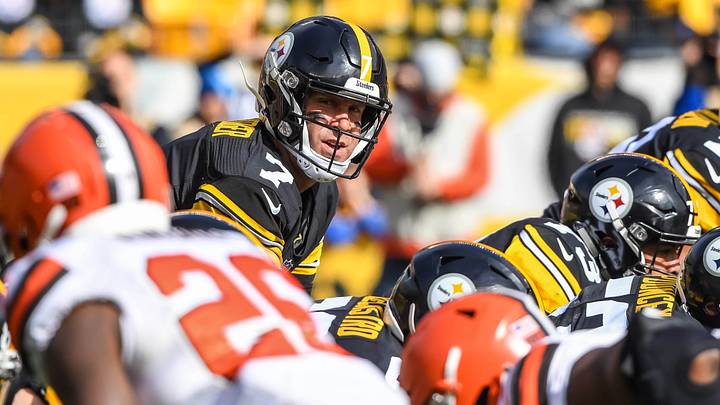
It's a well-known story in Cleveland that the Browns could've had Roethlisberger, but obviously, they passed. In an ESPN feature about the mind-numbing decision, then head coach Butch Davis made clear (with all due respect) the unfathomable ineptitude that permeated the front office's walls. The team instead drafted University of Miami tight end Kellen Winslow II.
"We had been competitive, so we thought, who could be a potential stopgap for a year or two, an older, experienced veteran guy and a great mentor? That's when we signed Jeff Garcia [in March 2004]," Davis said, via ESPN's Jeremy Fowler.
"You want that first-round pick who will be a significant contributor. It can't just be a need pick. You want to get the best player. You just knew [Winslow] was a really good player and we really needed to try to get guys on offense that could help. We were struggling to score points. We needed offensive help quickly. We didn't have any tight ends on the team that would be a real threat. If [Winslow] hadn't gotten hurt, he was the kind of guy like Jimmy Graham, you can place him in different formations and personnel groupings. That would be a three-to-five-time Pro Bowl player."
To openly state that the player in question would be a one-or-two-year stopgap shows there was no confusion about Garcia's role. They didn't have delusions of grandeur that he was a long-term answer. Yet they passed on Roethlisberger anyway because, well, reasons. Making matters worse is the fact that in explaining the logic for opting for Winslow II, Davis explained precisely why quarterback should've been the selection.
If you're struggling to score points, the single greatest force multiplier to solving that issue is the quarterback. Roethlisberger made all the sense in the world for the Browns at this slot. He's from Ohio, played college football at Miami (Ohio), and wanted to go to Cleveland. Naturally, the Browns saw the opportunity and must've thought it was too good to be true.
The other part that needs to be said: in this series, we're never going to chide the Browns for passing on a Tom Brady, Brock Purdy, or Russell Wilson. Those players were passed on by even the teams that drafted them multiple times. That would be unfairly revisionist. When we're talking about the 2004 class, however, these quarterbacks were highly touted.
Manning went first, Rivers fourth, and Roethlisberger 11th. There were rumblings that if the Giants couldn't swing a deal for Manning, they'd have gone with Roethlisberger at No. 4. These were blue-chip prospects, and when it came to Roethlisberger, the Browns simply outsmarted themselves.
To put a bow on the whole saga, Big Ben went 26-2-1 against Cleveland over his career with 6,896 yards, 43 touchdowns, and 23 interceptions. Surely he held no grudges over his nearly two-decade career. Definitely not.
The lesser-known Philip Rivers rabbit hole will have Browns fans steaming
When it comes to Philip Rivers, few have ever linked him to the Browns. He went No. 4 in the draft and the Browns ultimately picked No. 6 after a draft-day trade-up. End of story, right? Not quite. See, the 2003 season was kind of an embarrassment for the NFL. The Browns finished with only five wins, making their actual pick seventh.
There were four four-win teams in 2003 — the Chargers, Raiders, Cardinals, and Giants. There were also six five-win teams — the Commanders, Lions, Browns, Falcons, Jaguars, and Texans.
Back in Week 17 of 2003, the Browns were 4-11. They faced off against their in-state rival Cincinnati Bengals and pulled off the upset. That meaningless victory single-handedly dropped them from No. 4 to No. 7. If they had lost that game, it's almost a foregone conclusion that Philip Rivers would've been a Brown.
You don't have to just take it from me, either. Butch Davis echoed the sentiment and reminisced longingly about his time spent with the eventual eight-time Pro Bowler.
"I guess we probably had them Philip 1, Ben 2, Eli 3 if I had to guess. That's totally off the top of my memory. All three had great qualities. I just know there were so many good feelings about Philip. We put Philip on the dry board and spent a good 3-4 hours absolutely dissecting everything, reading coverages and audibles and changing protections. It's easy to see why he had a great career."
The president and CEO of the Browns at the time, Carmen Policy, also backed up the take, via Fowler:
"If we had the opportunity, as I understand that, we would have definitely taken Philip Rivers over Ben Roethlisberger, based on the evaluations of the personnel department. I think that they felt ultimately Rivers wouldn't be there. If he did wind up there, I think we would have taken him. If I'm not mistaken, that was a draft-day effort [to trade up for Rivers]. I did hear that after the fact."
In summation, the Browns blew their chance at Rivers — a player they loved in the pre-draft process — because they won a meaningless Week 17 game against a division rival. They passed on another legend in Roethlisberger, well, because he wasn't Rivers. The logic of selecting Winslow further collapses on itself with the knowledge that the Browns would've selected Rivers if he had been available.
The Browns still couldn't resist drafting a quarterback
This wasn't about selecting a player who was going to help immediately. This was about the Browns thinking they were smarter than the rest of the league as it related to Roethlisberger. At least they didn't ignore the position entirely in the draft. They picked Luke McCown in the fourth round and got four winless starts out of him.
The single greatest thing about McCown's Cleveland tenure is that more than a decade later, the Browns inked his brother, Josh, to be their bridge QB, a move that forced them to add a first initial ahead of 'McCown' on the infamous jersey. How can you not be romantic about football?
As difficult a pill as the 2004 season was to swallow, the NFL kept chugging along. The Browns had to lick their wounds and try to bounce back. In 2005, they found themselves in a familiar position of needing a veteran quarterback. Surely it can't go as poorly as it did in 2004 ...
— This series will continue with Chapter 3 on Saturday, July 11, and Chapter 4 on Sunday, July 12. See Chapter 1, "The Right Pick, the Wrong Plan," here.
 Add us as a preferred source on Google