

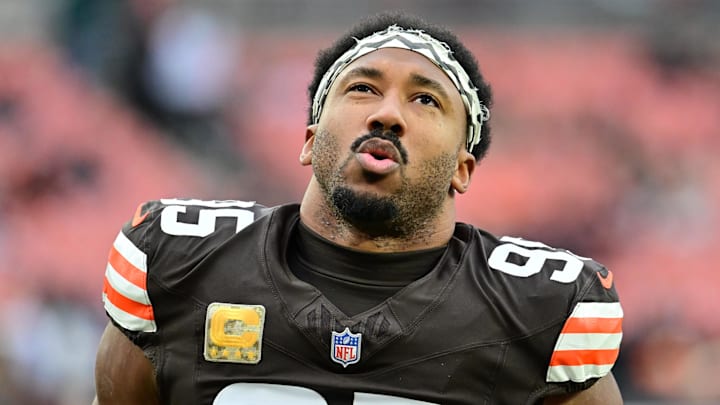
There is an epidemic spreading through NFL discourse at all levels. The dreaded "timeline" talk has reached the point where a reasonable fan may start to believe there's no point to their favorite team even existing if they don't have a top-10 quarterback. It's as though the generations of kids who grew up playing the Madden video game all collectively came to the idea that real life is just like the game.
Let's get this out of the way early: Albert Breer is a fantastic reporter, insider, writer, and any other title he deservedly receives. He cut his teeth in the business and became one of the most well-respected sources of NFL news out there.
Breer's latest Myles Garrett trade take, however, is a microcosm of the issues plaguing coverage of teams that are down in the dumps, like the Cleveland Browns.
"My buddy Conor Orr wrote this week that the Browns should trade Myles Garrett, and, as wild as it sounds, I wholeheartedly agree with him," Breer wrote. "The Browns’ timeline doesn’t really match up with Garrett’s. If you presume the quarterback of the future isn’t on the roster right now—and that’s with all due respect to Deshaun Watson, Shedeur Sanders and Dillon Gabriel—then we’re talking about it being 2027 before that guy arrives, and that guy potentially being a rookie then."
Why the Browns’ timeline might not be as far off as it seems
For starters, despite these national voices presumably following the game and all the happenings on a year-to-year basis, they conveniently forget even the most recent history on occasion.
In 2024, the Jacksonville Jaguars finished 4–13 with a quarterback, Trevor Lawrence, who people were starting to really wonder about. A head coach change later and voila, the Jags won 13 games and were the No. 3 seed in 2025. Surely no other team accomplished something like that though, right?
Wait, the New England Patriots went from 4–13 in 2024 to ... the No. 2 seed in 2025 with a 14–3 record? That's interesting. Well, those teams played in weaker divisions with some of the worst teams. That probably explains it. No way a team in the best division — the NFC North, which only featured teams with winning records — could complete a turnaround like that.
The Chicago Bears were 5–12 in 2024. It wouldn't be possible that they would climb out of the dumpster and win the division over the Lions, Packers, and Vikings (all playoff teams in 2024). There's simply no way. But they did — as the No. 2 seed with an 11–6 record.
You get the point. Things change quickly in the NFL. Sometimes a rookie QB hits the ground running and a team goes from doormat to contender in just one season (see: Jayden Daniels and the Washington Commanders). Sometimes the pendulum of fortune swings the other way, and those one-play bounces that cost a team five games bounce back and they win them instead.
Deshaun Watson's cap carnage will hurt but not cripple the Browns
Another way that Breer framed the difficulty the Browns face, thus justifying trading Myles Garrett, is with their upcoming cap crunch due to the Watson contract.
"On top of that, next year, they’d also be dealing with nearly $90 million in dead money assigned to the [quarterback] position, with the cap debt the Browns pushed forward coming due. So that would mean the target for all this to really take flight would be 2028. Garrett will start that season at 32 years old and finish it at 33."
The Browns' treacherous cap situation has been somewhat overblown, and the rounded-up $90 million figure here adds to the confusion. Cleveland Browns expert Ryan O'Leary gave a master class on how the Browns can (and likely will) handle Watson's contract upon its expiration. In summation, that figure will be split into two years at $34.6 million (2027) and $51.5 million (2028). While this will hurt, it's not the albatross it's been made out to be.
The Denver Broncos released quarterback Russell Wilson ahead of the 2024 season, incurring $85 million in dead cap charges that they split over two years. They made the playoffs in 2024 and were the AFC's No. 1 seed in 2025.
Pundits should stop projecting Myles Garrett's decline based on others
While Father Time is truly undefeated, continuing to treat players as though they all follow the same script is a fool's errand. Tom Brady played until he was 45 years old. That's certainly an outlier, and if Garrett's been anything for the entirety of his career, it's been a rare breed.
It's not a guarantee that he will lose his ability in a year or two, and if anyone believed that, no team would be willing to trade upwards of three first-round picks for his services.
What's more, few batted an eye when the Steelers handed a then-30-year-old T.J. Watt a three-year extension at $41 million a year. Nor did they question the Ravens handing 31-year-old Trey Hendrickson a four-year deal worth $28 million a year just this month.
All of this is to say, no, the Browns shouldn't trade Myles Garrett. It's not Cleveland's duty to send their best player to a playoff team to help them win a Super Bowl. The goal should always be to build the absolute best team possible to compete for a championship.
It's an undeniable fact that Myles Garrett aids the Browns in that quest. Maybe the Browns are 2026's surprise team. If not, maybe they'll be the next team to draft a rookie signal-caller who looks the part of a veteran from the time he hits the field in 2027. Stranger things have happened, and if Garrett's on the team, they'll be better-positioned to make a run than if they sent him away for unscratched lottery tickets that may turn out to be half as good as the future Hall of Famer.
 Add us as a preferred source on Google