

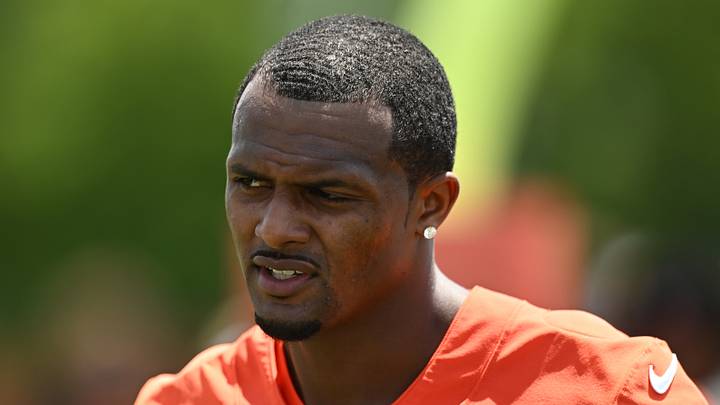
No matter how the Cleveland Browns’ quarterback competition plays out in training camp later this summer, the failed Deshaun Watson era has almost certainly reached its final months.
The Browns will essentially have two options when March of 2027 arrives: use a post-June 1 release to officially sever ties with Watson’s contract and eat the remaining dead-cap charges in 2027 and 2028 (estimated at about $86.2 million, per Over the Cap); or sign Watson to some sort of extension that tacks on additional dummy years and kicks the can even further down the road.
The chances of the latter option being seriously considered by Cleveland’s front office are slim to none, as Watson has only started 19 total games since signing his fully-guaranteed, $230 million contract in 2022. His Browns tenure has been nothing short of a disaster, and the team will almost certainly move on as soon as March arrives.
Mike Florio of Pro Football Talk recently answered a piece of fan mail on Watson that only drives that point home further. He discussed the Browns’ pending injury insurance credits from Watson missing half of 2024 and all of 2025 due to his Achilles injuries, and while the exact number has not yet been made public, it should provide Cleveland with substantial financial benefits at some point during the 2026 league year.
“I don’t know the specific answer, but it has to be significant,” Florio said of the pending insurance credit. “They had a policy. It pays out millions if he suffers an injury that keeps him from playing. And this isn’t something the team’s advertised. It isn’t something that gets filed with the NFLPA. It’s a number that I’m going to have to go out and construct. So … I don’t have the answer for you now, but it’s on my list of things to explore: What was the ultimate bottom line savings, as a practical matter, for the Cleveland Browns in cash and cap space?
And remember, the way they structured his contract — this is one of the reasons he’s still on the team, the five-year, fully-guaranteed contract, $46 million a year — they have kicked the can, and kicked the can, and kicked the can going with the smallest possible cap hits in the early years. They’ve got some big cap charges still left. Last year’s insurance payments, and the cap credits from those, will help make it easier as the Browns move into the non-Deshaun Watson cap years that are coming up in 2027, 2028, and I think they’ve smoothed it all the way out to 2029.”
What we know about the Browns' pending Deshaun Watson insurance credit
Nowadays, NFL fans have excellent resources like Spotrac and Over the Cap to make sense of player contracts and keep their favorite teams honest. Long gone are the days of owners and GMs explaining away a big personnel decision “because of the cap.”
It’s now common knowledge that teams routinely spend way over the salary cap in terms of real cash on player salaries. The Browns, since signing Watson to his five-year deal in 2022, have been one of those top-spending franchises under Jimmy Haslam.
Any financial relief for Watson having missed the team’s past 27 games would be appreciated in Cleveland, and based on what we can piece together from reliable sources, Florio is 100 percent right — some type of financial benefit is likely coming the Browns’ way. Cleveland's insurance on Watson's contract should help ease some of the burden of the dead money that will inevitably hit its books in future seasons.
But while Watson earns $46 million per year on average, injury insurance isn’t as simple as Cleveland getting that full sum back in the form of a salary-cap credit.
According to former NFL agent Joel Corry of CBS Sports, and Browns cap guru Jack Duffin of 247sports.com, Cleveland should expect to receive a percentage of Watson’s 2025 base salary in the form of a 2026 cap credit, likely within the projected range of $18 million to $26 million.
In the end, this should end up being good news for everyone involved next spring. Watson will get all the money he's owed along with the chance to start fresh as an unrestricted free agent. And the Browns should get at least a healthy sum of cap savings to roll over into 2027 and help ease the transition from one of the worst trade and contract decisions in NFL history.
 Add us as a preferred source on Google