

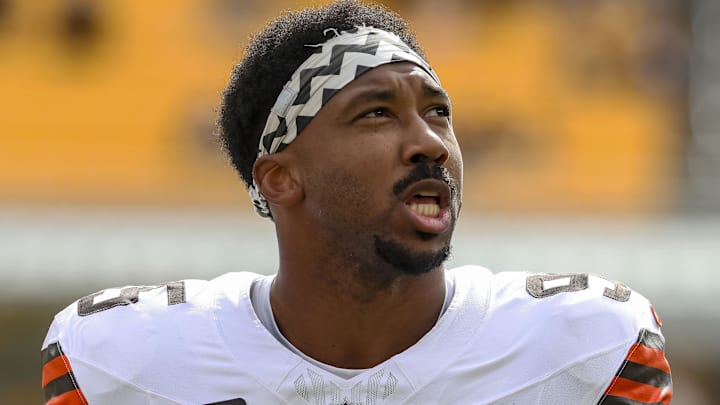
The Cleveland Browns made a fishy amendment to the language in Myles Garrett’s contract last week, and it didn’t take long for fans and members of the media to immediately engage in trade speculation.
In a nutshell, Garrett and the Browns agreed to defer option bonus payments in his contract from late March to early September. The move didn’t create any immediate salary cap savings for the Browns, and did little outside of establishing a new five-month window for Garrett and the team to, hypothetically, explore a trade.
Browns GM Andrew Berry attempted to shut down any and all trade chatter involving Garrett on Sunday during a session with local reporters at the NFL Owners Meetings in Phoenix. But as Zac Jackson of The Athletic pointed out, Berry failed to deliver the line that Browns fans expected (and have heard before).
What Andrew Berry didn’t say about Myles Garrett might matter most
Unlike the 2025 offseason, when Berry was adamant about the Browns not acquiescing to Garrett’s public trade requests, Cleveland's GM noticeably took a much more political approach this time.
According to Jackson, Berry stiff-armed any and all questions related to Garrett’s future with the team, while this time being careful to also leave all options on the table.
“I guess probably the easiest thing to say is, if we wanted to trade Myles, we wouldn’t need to make a contract adjustment,” Berry said, “so it doesn’t have anything to do with that.”
Despite the amended contract, two things currently stand in the way of Garrett potentially waiving his no-trade clause and playing elsewhere in 2026: timing and practicality.
Trading Garrett prior to this year’s draft would leave the team with a $41 million dead-cap hit. That’s not happening, as Garrett’s current 2026 cap number of $23.6 million is beyond reasonable. It would be one thing to trade a future first-ballot Hall of Famer while he’s both under contract through 2030 and still in his prime; it would be another if that move cost the team an additional $17.4 million in cap charges this year just to make it happen.
The timing of any hypothetical trade would thus come after June 1, when Berry and company could spread the leftover dead money over two years. In that scenario, the Browns would actually save $8.1 million in cap space, while the acquiring team would absorb his full $31 million-plus cash salary for 2026, thanks in part to this year’s now deferred bonus payment.
Those savings don’t make a Garrett trade this summer any more practical, though. The Browns are about to enter the Todd Monken era, and their current depth at edge rusher leaves much to be desired. It seems highly unlikely that the team would explore trade options with Garrett this June, before Monken even coaches a game in 2026, for a package centered upon first-round picks in 2027 and beyond.
It’s all conjecture at this point, but here’s what’s undeniable: Berry stopped short of completely ruling out a Garrett trade this year, and the team’s now in prime position to move him next offseason, or in 2028, when a pre-draft trade would actually provide salary cap relief, instead of the other way around.
Garrett will almost certainly end training camp on the Browns’ roster this summer. The odds of him getting moved over the next two to three years, though? Those appear to be rising.
 Add us as a preferred source on Google