

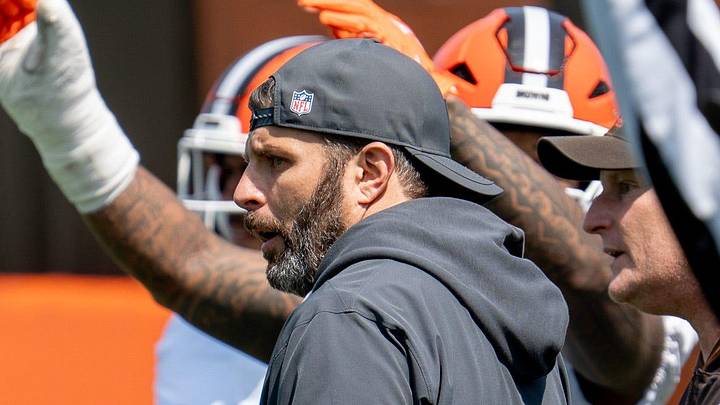
For the better part of the past decade, the Cleveland Browns had the luxury of being one of the NFL’s best do-what-we-do defenses.
As ESPN’s Ben Solak recently pointed out, the Browns rarely had to reinvent the wheel with elaborate schematic wrinkles. When you have Myles Garrett rushing off the edge, commanding the opponent’s attention on every snap, you can afford to be more predictable on the second and third levels.
Even under former defensive coordinator Jim Schwartz, the Browns dared their opponents to beat their tried-and-true formula. And despite the disappointing win-loss results, Cleveland’s defense often ranked among the NFL’s most efficient units under Schwartz's watch.
Solak believes that predictability factor could be the hidden benefit of the Garrett trade, aside from the addition of ascending star Jared Verse and three future draft picks, including a 2027 first-round selection from the Los Angeles Rams.
Under new DC Mike Rutenberg, the Browns have a chance to be something they didn’t often have to be during the Garrett era: deceptive on defense.
“The Browns' secondary is built to play single high, as Schwartz (often to his detriment) committed to playing with an extra body in the box while the rest of the league permitted light boxes, as is the modern style. The Browns' secondary of cornerback Denzel Ward and safeties Ronnie Hickman and Grant Delpit was talented enough that Cleveland could just line up and play with great success
“But disguise does not need to be the opposite of aggression. Schwartz's coverage approach has long been predictable, and predictable is exploitable even when Garrett is breathing down your neck. Last season, nobody ran less quarters or fewer zone blitzes in the league. The Falcons were top five in both under Rutenberg in 2025 by Next Gen Stats' coverage model.”
The Browns' defense could take on an entirely new identity in 2026
While the addition of Verse made the decision to trade Garrett more palatable from a fan’s perspective, it’s the overall shift of Cleveland’s defense that could become one of the more intriguing storylines of this 2026 season.
There will be no avoiding the Verse-Garrett comparisons and side-by-side graphics showing their respective sack numbers during broadcasts this year. But that shouldn’t be how Cleveland’s success is defined. While Rutenberg’s scheme is Schwartz-adjacent, he never directly worked under Schwartz, or on the same staff as Monken prior to taking the Browns' DC job this offseason.
There will be portions of the scheme that feel like review for the Browns' defensive veterans, Solak said, with plenty of new wrinkles sprinkled in. Deceptive zone looks and secondary blitzes could quickly become the new staple of a unit that was mostly treated nationally like a one-man band during Garrett’s tenure.
“Rutenberg will breathe schematic freshness into Cleveland without sacrificing the identity of what has been a phenomenal unit in the past few years. And with the Garrett trade, that schematic freshness might suddenly become more necessary. The Browns cannot rely on a four-down rush nearly as much as they used to because they don't have the generation's best pass rusher on the roster any longer. Schwartz would have had to change even his near-permanent stripes — with Rutenberg, the Browns have a better chance to make that change quickly and effectively.”
Did the Browns get better for the 2026 season after trading Garrett? The answer to that question, unequivocally, is no.
But could they quickly look more modern and deceptive on defense now that the linchpin of their operation has been removed? That could be the subtle benefit that ultimately defines this move over the next few years.
 Add us as a preferred source on Google