

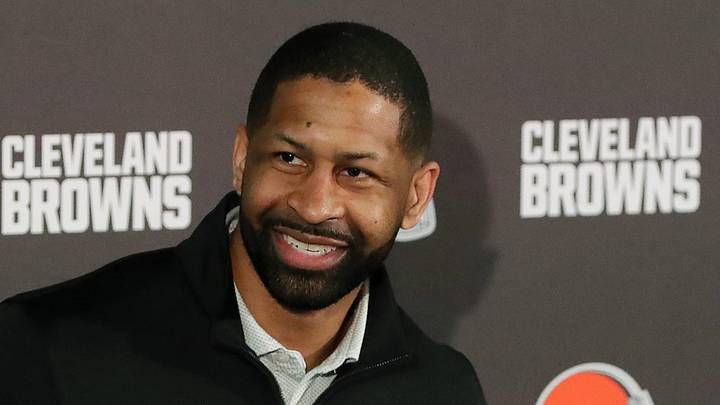
There was plenty of action around the NFL on trade deadline day, but general manager Andrew Berry and the Cleveland Browns opted to sit this one out.
Was that the prudent approach? Honestly, it’s hard for any Browns fan to argue against it.
But does it get fans fired up for a hopeful playoff push in the second half of the season? Absolutely not.
As usual with a decision of this magnitude, there’s a trickle-down effect. No team should just trade away draft picks to say they did, and per longtime Browns reporter Mary Kay Cabot, Berry worked the phones but couldn’t find a deal that made sense. That happens.
But the long-range vision has been crystal clear since the offseason, and Tuesday just cast a bright light on it.
On that note, here are the biggest winners and losers from Cleveland’s silent deadline day, starting with the most obvious.
Winner: Andrew Berry
Berry’s pulling the strings, but he’s the biggest winner here.
He’s clearly been empowered by Browns’ ownership to see his vision through. That includes holding onto his war chest of 11 selections in the 2027 NFL Draft (and another eight in 2028) and letting this season play out as a developmental year with a bridge quarterback in veteran Deshaun Watson and the NFL’s second-youngest roster.
Loser: Browns fans
Browns fans understand the team’s current timeline. No one was really expecting major fireworks like Jonathan Taylor or Jeffery Simmons.
But something? Anything to sharpen the edges of the roster at spots like tight end, defensive tackle, or edge rusher? That would have at least signaled to the fan base that team brass is as serious about the prospects of this season as it is about 2027 and beyond.
The Browns are 5-4. They have four home games and a bye over the next five weeks. They’re right in the thick of the AFC playoff hunt.
They also have seven Day 3 draft picks in 2027, and a move for this year would have hit harder than another fifth-round dart throw in another 170 days.
Winner: Todd Monken
What does making no major roster moves (other than the Myles Garrett trade back on June 1) mean for Monken? Less pressure.
The first-year NFL head coach is working through his own growing pains. The Browns have the league’s worst scoring margin in the first quarter of games, and they also lead the NFL in penalties.
This is a developmental year for Monken and the coaches, as well. The pressure will naturally ramp up in Year 2, after what’s expected to be a more aggressive approach to free agency and another exciting NFL Draft. But Cleveland’s 60-year-old head coach is kind of playing with house money right now.
Loser: Harold Fannin Jr.
A loser? Fannin? The player who just earned Kyle Brandt’s Angry Runs scepter on Good Morning Football?
Yes, the deadline was kind of a killer for Fannin, who’s been carrying Cleveland’s tight end room for nine weeks. Now, there’s no end in sight.
Cleveland really could have used a sidekick for Fannin, preferably a more natural inline tight end who can handle the bulk of the chip and blocking duties. That help isn’t coming. The Browns will roll with Fannin and veteran Blake Whiteheart for the foreseeable future.
Winner: Jerry Jeudy
This one could go either way. On one hand, Jeudy’s targets are way down this season, as he’s essentially the fourth option in the passing game behind Denzel Boston, KC Concepcion, and Fannin. A move to a contending team — like the Los Angeles Rams, perhaps? — could have thrust Jeudy into a more prominent role.
On the other hand, Jeudy does have a role with the Browns. He’s been a solid veteran presence for the team’s young receivers and seems to come up with monster catches whenever Cleveland faces a gotta-have-it-situation in the fourth quarter.
Joining a new team midseason can be tricky. It doesn’t always work out (see Amari Cooper, Buffalo). Jeudy’s an injury away from seeing a major uptick in opportunity with Cleveland, and that feels like the best spot for him for the rest of 2026.
Loser: Dillon Gabriel
Speaking of a change of scenery, that would have been a good thing for Gabriel — and the Browns kind of owe him one, too.
The back injury that forced Gabriel to miss the first seven games of the season? It was suspect, at best. He played ball, though, and Berry smartly utilized a loophole that allowed him to keep all four quarterbacks on the roster while saving a spot on the 53-man roster over the first two months.
Gabriel is now back on the active roster as Cleveland’s No. 3 quarterback, but this is a crowded situation. He’s well behind both Deshaun Watson and Shedeur Sanders, and the new regime just invested an early sixth-round draft pick in Taylen Green, an exciting dual-threat QB who isn’t going anywhere.
With so many injuries (and ugly quarterback play) around the NFL this season, Gabriel seemed like a reasonable sell candidate for Berry. But the opportunity to go elsewhere with a better chance to play never materialized, and Gabriel remains buried on a crowded depth chart as a result.
Winner: Shedeur Sanders
Monken refused to admit it on Monday (for some reason), but Watson is expected to resume his role as Cleveland’s starter in Week 10 after missing one game with a concussion. Sanders, meanwhile, played — and performed extremely well — in the Browns’ overtime loss to the Saints last week, boosting his stock.
Sanders may not have done enough to send Watson to the bench (the Browns did lose that game to the Saints), but he proved that he’s a capable NFL starter when called upon, and he seems to be developing into an asset much more valuable than his fifth-round pedigree.
The Browns’ plan at quarterback for 2027 remains up in the air, with Watson’s contract set to expire (technically, he’ll be designated as a post-June 1 release for salary cap purposes) and the team holding a pair of first-round picks in next April’s draft.
Sanders, who wasn’t expected to be traded on Tuesday, remains firmly in the mix — and he may be showing Monken enough to be a viable option to enter next season as the starter.
Losers: Browns defensive line depth
If Cleveland made a move before the deadline, defensive end or the interior D-line felt like the most likely spot. Top defensive tackles Maliek Collins, Mason Graham, and Mike Hall Jr. have missed a combined six games this season. Pass rushers Jared Verse, Isaiah McGuire, and Derek Barnett have a combined three sacks (all from McGuire).
Ultimately, the Browns’ decision to stand pat at the deadline was not surprising, but passing on adding help along the defensive line stands as the biggest disappointment.
It didn’t have to be a major move, but an addition to help create more organic pressure, or to aid the team’s struggling run defense, would have gone a long way.
 Add us as a preferred source on Google