

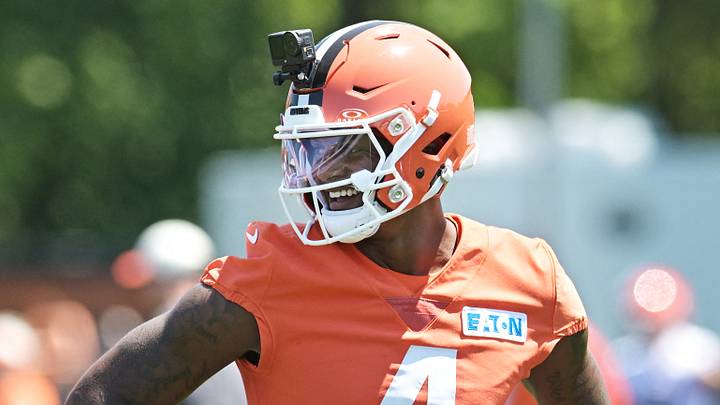
When Deshaun Watson arrived in Cleveland, an invisible dark cloud appeared over the organization, the practice fields, the stadium, and really anywhere Browns football is enjoyed. It hasn't dissipated in the years since, save for a short sabbatical toward the end of the 2023 season.
It played out a lot like a horror movie. Fans were forced to sit idly by as the main characters ignored every blinking red warning sign, throwing caution to the wind in their pursuit of a player who carried with him copious amounts of baggage. The end result was predictable, though that doesn't make it any less painful.
In 2026, the Browns have finally reached the final season of the ill-fated five-year, $230 million contract Cleveland needed to dole out to entice the controversial signal-caller to waive his no-trade clause. Fans were finally beginning to see the light at the end of the tunnel, that is, until owner Jimmy Haslam spoke to the media on July 31.
Could Deshaun Watson's Cleveland stay actually extend beyond 2026?
Haslam was asked whether there was a world in which Deshaun Watson could perform well enough to earn a contract extension that will keep him with the franchise into the future. While the loaded nature of that question is not lost on anyone, the response was unnerving all the same.
"I think there are all kinds of possibilities out there — so, yes," Haslam said.
Now, should we have expected anything different from the owner of the team? It's complicated. This is the same man who was shockingly candid when he said the Browns took a "big swing and miss" when they made the trade for Watson in the first place. Now, there's a delicate balance to be struck, but Haslam could've said something along the lines of: "We're worried about today, right now," and everyone would feel a lot more comfortable.
Still, he left just enough meat on the bone to entice reporters to follow up with Deshaun Watson himself when he was available for questions. Like Haslam, Watson didn't dismiss the possibility outright. In fact, he took the opportunity to wax poetic about his love for the City of Cleveland and push back against narratives that have followed him since his arrival.
“Oh, for sure. When I first got here, there was a lot of stuff going on, as the world knows," Watson said. "But I don’t have any bad feelings toward Cleveland. I love Cleveland. Me and my wife have our house on the east side, so we’re here all the time. We were here this summer.
"If you ask around, I’m at pretty much all the restaurants, hanging out, so I haven’t had a bad experience outside of different times in the stadium. I don’t know why that narrative is out there that people think that I don’t like Cleveland. My family and I have been enjoying our time here, if the opportunity shows up, we’ll see where it goes."
Cleveland's salary cap makes a Watson extension extremely unlikely
It's understandable that some fans might take these comments at face value. Here at Dawg Pound Daily, we dove into the feasibility of Deshaun Watson sticking around in Cleveland for another year to try to answer those kinds of questions.
The good news? It's highly unlikely that the Browns would be willing to orchestrate the salary-cap shenanigans necessary — barring an unthinkable MVP-type season from Watson — to keep him around.
The bad news is the Browns will still be paying for Watson on their salary cap in 2027 and 2028 whether he sticks around or not. Of the $230 million that Watson has pocketed over the last four seasons and will pocket in 2026, only $143.8 million has been (or will be) accounted for on the salary cap. That leaves $86.2 million to be absorbed over the subsequent seasons, split up into a $34.6 million charge in 2027 and $51.6 million in 2028.
The primary way the Browns would be able to divvy that chunk of change over two years is by making Watson a post-June 1 cut at season's end. If he were to be extended, general manager Andrew Berry would be forced to devise a seriously convoluted contractual structure that folds in the $86.2 million that is still owed on the cap, and that's before even mentioning the additional compensation Watson would ask for.
After a near quarter-billion-dollar investment came up lame, it's hard — no scratch that, mind-altering — to imagine Browns ownership paying another cent to a player who provided so little return on investment. While the sizable cap charges remain, the Browns will no longer owe Watson real cash beyond 2026, netting $46 million in average annual cash flow they haven't had in recent seasons.
Fans shouldn't take these comments at face value. These are the kinds of things people are forced to say when they're caught in an impossibly awkward pickle and they're mercifully waiting for it all to end.
Don't fret, fans, what may wind up being the darkest period in franchise history is coming to an end — even if the parties involved refuse to say it publicly.
 Add us as a preferred source on Google