

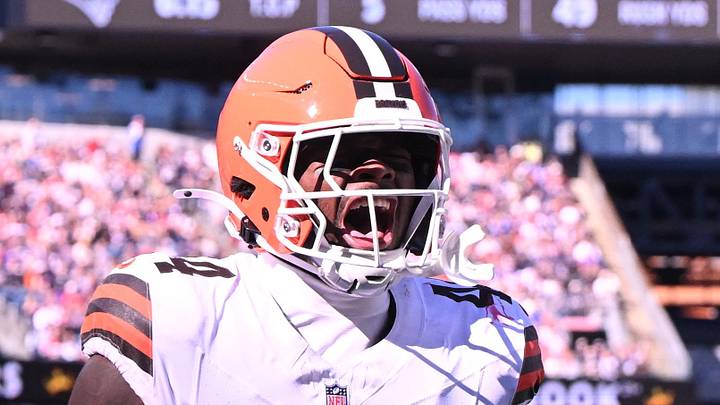
Harold Fannin Jr. won’t be eligible for a contract extension until the 2028 offseason, but the Cleveland Browns should already be doing some advanced planning with the NFL’s tight end market suddenly booming.
Two notable deals got done this week, with the most interesting being Jacksonville’s Brenton Strange. He was a late second-round pick in the 2023 draft and has been a productive, three-down tight end for the Jaguars.
But was Strange widely viewed as a priority signing within the second tier of the NFL’s tight end market? For a player who hasn’t yet topped 50 catches or 600 yards in any of his three seasons, that’s debatable.
Strange signed a three-year, $48 million extension with Jacksonville this week. His $16 million per year now ranks him among the top five tight ends in football. He’s currently behind George Kittle ($19.1M), Trey McBride ($19M), and Kyle Pitts ($18M) in average annual value.
Pitts also recently signed his deal after the Atlanta Falcons initially used a franchise tag on him this offseason. He was able to leverage his breakout 2025 season when he posted career highs in targets (118), catches (88), and touchdowns (5).
Fannin compares more closely with Pitts as a dynamic receiving and yards-after–catch weapon than an all-around tight end like Strange. The only real difference between the two is draft capital, as Pitts was taken with the No. 4 overall pick in 2021.
The Browns stole Fannin in the third round of the 2025 draft, meaning he’ll be entering the final year of his rookie contract when he becomes eligible for an extension following the 2027 regular season.
If he continues to produce at last year’s rate, when he led all Browns receivers in just about every pass-catching category, his next contract could end up being a market-setter.
The NFL's rising tight end market is setting Harold Fannin Jr. up for a massive payday
The good news for GM Andrew Berry and the Browns is that they should be in a much better salary cap situation come 2028, when Fannin and their other top 2025 draft picks will be due for big paydays. They currently rank No. 2 in the NFL in 2026 dead money (cap hits for players no longer on the roster) at $116.8 million, per Over the Cap. By 2028, they’ll be in the final stages of officially moving Deshaun Watson’s cap hits off their books. They'll likely also have the luxury of building around a cost-controlled quarterback, assuming they target one in next year's talent-rich NFL Draft class.
If Fannin can stay healthy and continue producing at his current rate, he could be in the Tier-1 conversation for his next deal. Kittle’s market-setting contract in 2025 — four years, $76.4 million with $35 million guaranteed — accounts for about 7 percent of the NFL’s current $301.2 million salary cap number.
That number has been rising with each new league year, with Over the Cap projecting it to grow to $327 million in 2027 and a whopping $352 million in 2028. Using that latter number, at around 6.5 percent to 7 percent, Fannin’s next contract could easily surpass $90 million.
It’s obviously still very early, but after the Browns let David Njoku walk in free agency and opted not to address their tight end room outside of a couple of fringe veterans and Day 3 draft selections, Fannin should be well set up for success. New head coach Todd Monken has been known to keep his top pass-catching tight end fed. He’s likely licking his chops after watching the slippery Fannin posted 72 catches for 731 yards and six touchdowns in 16 games last year.
Cleveland could have a few priority contract negotiations on the table in 2028 when Fannin, defensive tackle Mason Graham, linebacker Carson Schwesinger, and running back Quinshon Judkins all become extension eligible. Schwesinger’s contract could be at the top of that list after he won Defensive Rookie of the Year.
But based on positional value, Fannin’s deal projects as the biggest dollar figure of that group right now, and he has new friends like Pitts and Strange to thank for that.
 Add us as a preferred source on Google