

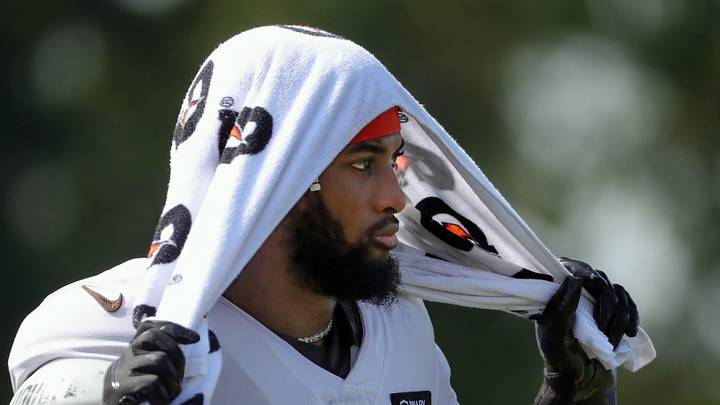
“There’s no sense in partially embracing a rebuild.”
Those words, written by The Athletic’s Zac Jackson following the conclusion of Cleveland Browns minicamp, are likely ringing inside the walls of team headquarters in Berea. They should be, at least.
Browns GM Andrew Berry admitted that, although the Myles Garrett trade was finalized promptly on June 1 — a key date on the NFL calendar for salary cap purposes — moving the franchise’s most valuable player wasn’t “Plan A” for this offseason. It was more of a pivot, Berry said, after the Los Angeles Rams came to the table with an offer that included ascending young pass rusher Jared Verse and a healthy package of draft picks that included a 2027 first-rounder.
By that logic, the Browns are currently embracing a pivot. They were more aggressive in free agency than most expected, ponying up for guard Zion Johnson among a flurry of moves to overhaul the offensive line. Adding veterans like Johnson, Tytus Howard, and Elgton Jenkins up front felt like the kind of win-now moves the Browns needed to find success in Year 1 of the Todd Monken era.
But months later, the Browns are set to enter training camp with one of the youngest rosters in football, a direction that coincides with the second-most dead money in the NFL in terms of the 2026 salary cap.
That’s why Jackson believes the team could lean heavier into its new direction and embrace a total teardown. That would involve trading two of its most important (and expensive) assets in defensive backs Denzel Ward and Grant Delpit.
“Yes, the Browns should trade Denzel Ward if they can find the right deal. As for the uncertainty with Grant Delpit ahead of the final year of his contract, the result should either be an extension or a trade, too," Jackson wrote. "There’s no sense in partially embracing a rebuild, and the team should swallow as much dead money as necessary on the salary cap in the next two seasons to get back to spending big money going forward.”
Denzel Ward and Grant Delpit could become the next dominoes to fall
After the Garrett trade was finalized, the Browns moved to $116.8 million in 2026 dead money (cap charges for players no longer on the roster), which ranks only behind the Miami Dolphins’ whopping $179.2 million following the release of Tua Tagovailoa, per Over the Cap. The NFL’s cap number this year is $301.2 million. Cleveland is thus operating on a much tighter budget than the league average, with over 38 percent of its 2026 cap committed to contracts of players who won’t be on the field in 2026.
The harsh reality is that the Browns’ dead-cap issues are just getting started. They already have $51.4 million on the books for next year, and that doesn’t include Watson, who is scheduled to be released with a post-June 1 designation in March of 2027. Cleveland’s dead money will soar well past $100 million again once that move is made.
As ESPN recently chronicled, the Denver Broncos emerged from a similar stretch of dead-cap purgatory following the release of Russell Wilson. They were able to land a serviceable starting quarterback in the draft, Bo Nix, and lean on a star-studded defense to remain competitive in the AFC, even as the front office managed a massive financial rebuild. It’s a blueprint the Dolphins appear to be embracing this year after Denver reached the AFC Championship Game in 2025.
The Browns have long been planning to do the same after reworking Watson’s contract following his first Achilles injury in 2024. The exit plan, due to his money being fully guaranteed, has always been March of 2027. Cleveland’s been managing his cap hits with annual restructures, and his remaining dead money (around $86 million) will be split up between 2027 and 2028.
So while Monken needs veterans like Ward and Delpit in his locker room to help lead a young roster, the team might actually be better off moving on now while it's still in the early stages of a financial reset. The Browns now hold two first-round picks in the 2027 draft and 11 selections overall. They could feasibly find their version of Nix, with plenty of young talent already in place to start ascending into contender-level status.
The Broncos are there, and entering 2026, they’re finally free to make major win-now moves — like trading for wide receiver Jayden Waddle — and legitimately hunt for division titles and Super Bowls.
The Browns won’t fully have Watson off their books until 2029, when Ward would be entering his age-32 season. Delpit would be 31.
As painful as it is to picture Cleveland’s defense without Garrett, Ward, and Delpit, Jackson does make a fair point. It could be the right long-term play to rip the Band-Aid off prior to this year’s trade deadline, rather than a half-measure that won’t make the current situation any better.
 Add us as a preferred source on Google