

Harold Fannin Jr. is one of the NFL’s best pass-catching tight ends, but through five games, the Cleveland Browns have a glaring problem brewing alongside him on the depth chart.
Unfortunately, it’s a problem that was painfully obvious during the offseason. GM Andrew Berry and the front office were way too casual in addressing that problem, and it’s now showing up in the one area head coach Todd Monken’s offense typically hangs its hat — the running game.
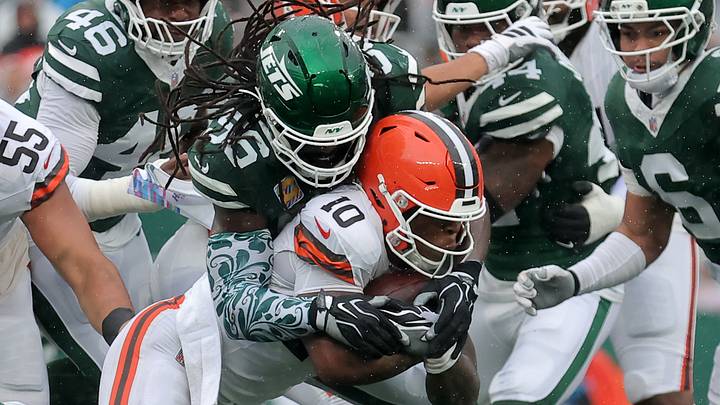
Quinshon Judkins has faced criticism for his slow start to 2026. He’s averaging 3.0 yards per carry and has yet to top 70 yards in a game. He only has one rushing touchdown in five games.
But only so much blame can be put on a young running back who’s often being asked to take slow-developing handoffs from Deshaun Watson out of the shotgun. Judkins would have to be Barry Sanders to gain more than a couple of yards on the majority of his carries right now.
Every run game snap broken down in-depth. 14 carries from Quinshon, 3 from Sanders, 3 from Watson.
— Browns Film Breakdown (@BrownsFilmBDN) October 12, 2026
The issues are mainly a mix of scheme, lacking up front displacement, and poor TE performance. Can the RBs be better? Sure. But they are not the problem.
🔗:… pic.twitter.com/WBw1Fq3dUF
The Browns' tight ends are becoming a major problem in the run game
Fannin routinely torments defenses when he runs a route as a receiver. He can be a liability in the run game, though, especially when asked to block bigger linebackers or defensive ends.
The only other tight ends who have played an offensive snap for the Browns through five weeks are Blake Whiteheart — who’s best served as a core special-teamer — and seventh-round rookie Carsen Ryan.
The harsh reality is that Cleveland has two rookies on the offensive line and no serviceable blocking tight ends to help reset the line of scrimmage in the run game. It’s leading to running lanes that quickly disappear, leaving Judkins in no-man's land.
Per Pro Football Focus’ grading system, the two worst run blockers on Cleveland’s offense, among players who have logged at least 35 snaps, are Fannin (41.4 grade) and Whiteheart (43.2).
Cleveland’s curious offseason approach at tight end is already rearing its ugly head
Most Browns fans understood the team’s decision to part ways with David Njoku, given Fannin’s rapid ascension as the team’s top tight end.
Not replacing Njoku remains the team’s biggest second-guess.
Cleveland entered training camp hoping Jack Stoll, who signed a veteran minimum-style contract in free agency, could operate as a blocking complement to Fannin. The veteran suffered a season-ending injury, though, and wasn’t a proven option to begin with.
The real solution was Berry’s double-down during the 2026 NFL Draft, which saw the Browns use Day 3 picks on Joe Royer (fifth round) and Ryan (seventh). Cleveland misjudged the run on tight ends on Day 2 of the draft, though. Royer ended up being the 15th tight end off the board, and he never returned to the team after the spring offseason program due to an unknown personal issue.
The whole situation has led to Whiteheart playing the first full-time offensive role of his career and Fannin lining up as an in-line tight end on 56.5% of his snaps. That alignment rate was 46.9 percent for Fannin in 2025, per PFF.
Judkins is shouldering the blame for what’s become an impossible situation. The Browns opted to save money at tight end this year, rolling with cheap veteran deals and rookie-scale contracts. The result is a group that’s getting beat up at the point of attack and severely limiting Cleveland’s effectiveness on the ground.
 Add us as a preferred source on Google